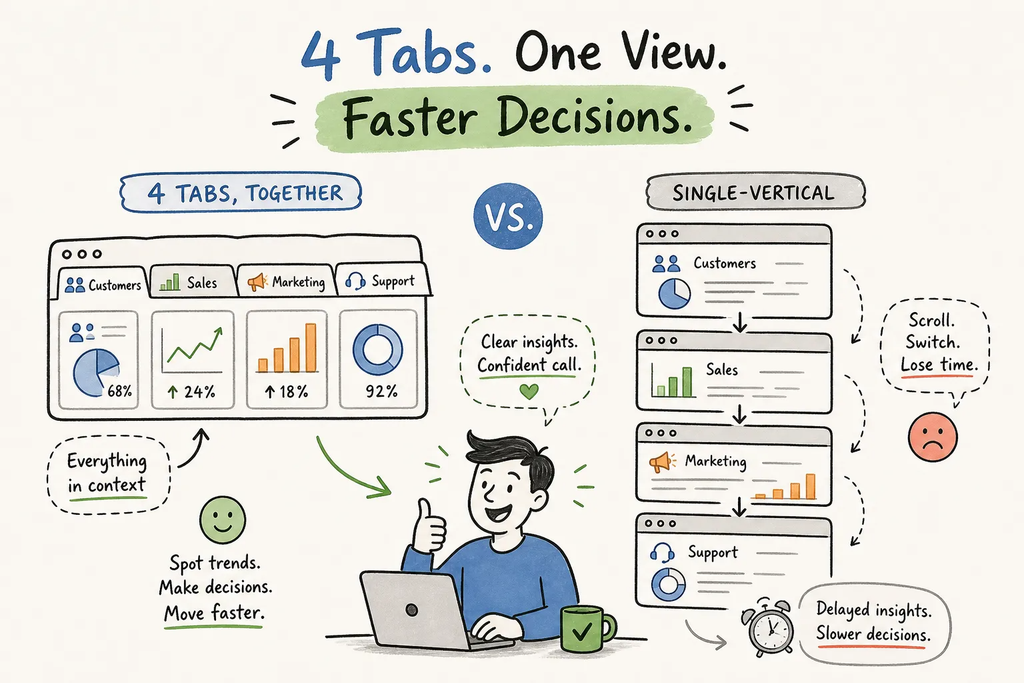
4 tabs, the shorthand for The Four Tabs, brings together four major search verticals, Jobs & Careers, Finance & Wealth, Auto & Financing, and Lifestyle & Marketplace, into a single curated platform. The result is faster, less exhausting decision-making compared to running separate searches across four single-vertical sites. Studies on consumer search behaviour place the typical Indian consumer at an inferred range of roughly three to five platforms per major purchase session, and 68% of Indian consumers report making connected decisions across two or more categories within the same research period. If you have ever ended a session with multiple browser tabs open, three shortlists saved in different apps, and no clear next step, that is precisely the problem this article addresses.
Single-vertical platforms are standalone services built for one category: a job board, a loan comparison site, or a vehicle aggregator. Each does its job reasonably well, but none connects to the others. This article walks through four real consumer scenarios, an honest comparison between consolidated and specialist platforms, and exactly where 4 tabs fits in that picture.
Key takeaways
- Connected decisions are common: 68% of Indian consumers make decisions across two or more categories in the same research period.
- Platform switching adds cognitive load: Every new platform demands a fresh orientation, different filters, different terminology, different account credentials.
- Four verticals, one session: The Four Tabs covers Jobs & Careers, Finance & Wealth, Auto & Financing, and Lifestyle & Marketplace in one place.
- Location filters apply everywhere: Set your city once and all four verticals update simultaneously.
- Over 1,000 curated listings: Every listing comes from a certified provider, so you compare vetted options rather than sift through unverified entries.
- Direct provider access: You connect to employers, lenders, dealers, and service providers directly, with no middleman.
Why does using multiple separate platforms slow you down?
The cognitive load of switching between platforms
Each platform switch carries a re-orientation cost. Separate interfaces, terminology, and account credentials can increase the mental effort required before you can make a meaningful comparison. A consumer researching a car loan on one site and vehicle listings on another is not simply opening two tabs; they are holding two separate mental models simultaneously. When four decisions, job search, loan comparison, vehicle research, and home services, run in parallel across different platforms, that cognitive overhead compounds quickly.
This is a well-documented pattern in UX and behavioural research. Cognitive load rises with fragmented information, and information overload is linked with online fatigue and a greater intention to abandon a session, even when the effort of switching keeps people stuck where they are. More information across more platforms does not necessarily improve decisions: when alternatives exceed processing capacity, choices become lower quality and less satisfying.
How fragmented search distorts priorities
Single-vertical platforms are optimised to keep you on their platform, not to help you make a connected decision. A job board surfaces roles but does not help you model how a salary change affects your loan eligibility. A loan comparison site shows interest rates but does not connect those rates to your relocation costs or the insurance products you will need for a new vehicle.
The result is that you become the integrator, manually stitching information across tabs. This stitching is itself a chain of decisions: what to record, what to discount, what order to act in. Each of these micro-decisions accumulates alongside the main financial or career decision. Decision fatigue research consistently shows that after repeated choices, people are more likely to delay, accept defaults, or abandon the decision entirely. In career planning or personal finance, avoidance carries real long-term costs.
What the 4 tabs model actually changes for Indian consumers
How organising by four verticals maps to real consumer life
The structure of The Four Tabs is not arbitrary. A job change affects income, loan eligibility, vehicle needs, and potentially housing or local services. A car purchase involves the vehicle listing, an auto loan, insurance, and possibly a relocation. The four verticals reflect the real shape of these decision clusters, not an artificial product taxonomy.
This is consistent with the data: the same 68% majority noted in the introduction are already navigating connected decisions across two or more categories in one research period.
Location personalisation as a multiplier
The Four Tabs applies location-aware filters across all four verticals simultaneously. When an Indian consumer in Pune searches for a job, they see roles, local lenders, nearby dealerships, and local services all relevant to Pune, without resetting location preferences four separate times. This compounding effect is what distinguishes a consolidated platform from simply having four bookmarks open at once.
Setting location once and having it apply across every vertical removes a small but meaningful source of friction from every session. This is especially relevant in a diverse market like India, where availability, regional pricing, and serviceable areas vary considerably between cities.
Four everyday scenarios where consolidation wins
A job seeker narrowing roles without losing sight of the bigger picture
On a standalone job board, they filter and shortlist. But when they want to know whether their shortlisted salary range supports a home loan or a car upgrade, they open three more platforms and start again from scratch. On The Four Tabs, they browse the Jobs & Careers tab, then pivot to Finance & Wealth and Auto & Financing within the same session. The search stays coherent because the platform holds all four contexts at once.
A borrower comparing personal loans without getting lost in rate tables
Standalone loan comparison sites show rate tables in isolation. The Four Tabs Finance & Wealth section surfaces vetted loan products from certified lenders; the consumer can then immediately cross-reference with Lifestyle & Marketplace listings, such as software tools for EMI tracking, without leaving the platform. The session stays connected rather than splitting into separate research threads.
A car buyer checking vehicle listings and financing in one session
Normally, that is four separate platforms: listings, loans, insurance quotes, and service centres. On the 4 tabs Auto & Financing section, listings, finance options, and insurance from verified providers sit in one curated space.
A homeowner sourcing local services without assembling a patchwork of referrals
The Lifestyle & Marketplace tab covers local services, solar, and property-adjacent categories alongside Finance & Wealth options. The consumer does not need a separate local services directory, a separate solar marketplace, and a separate bank website. One session covers all three threads, with location already set to Hyderabad from the start.
Where single-vertical platforms still have an edge, and where that stops mattering
The depth argument for specialist platforms
A dedicated job board may carry more raw listings in a niche category than a curated directory. A specialist loan aggregator may show more lenders in a narrow product tier. For a hyper-specialist search, a contract role in a rare technology stack, or a micro-ticket NBFC loan, a single-vertical platform built around that niche offers more depth, and that is a genuine advantage worth stating plainly.
Why depth without connection creates its own problem
For the majority of Indian consumers making connected decisions, depth on one vertical while remaining blind to the others is a liability, not a feature. Quantity of listings is not the same as quality of decision-making. The Four Tabs aggregates over 1,000 listings sourced directly from certified providers precisely because the goal is a trusted shortlist, not an exhaustive directory that requires you to do your own quality filtering. When the majority of consumers are navigating decisions across multiple categories simultaneously, a platform that handles only one of those categories is solving a fraction of the actual problem.
| Criteria | The Four Tabs | Typical single-vertical platform |
| Verticals covered | Four: Jobs, Finance, Auto, Lifestyle | One |
| Location filter scope | Applies across all four verticals at once | Applies within one vertical only |
| Provider verification | All listings from certified providers | Varies; often requires user-side filtering |
| Cross-category decision support | Native: switch tabs within one session | None; user must open additional platforms |
| Cognitive load per session | Lower: single interface and shared filters | Higher: different interfaces, credentials, and terminology per platform |
| Niche depth in one category | Curated shortlist of 1,000+ listings | Can be higher for specialist niches |
| Direct provider access | Yes: connect directly with the original source | Varies; some platforms route through intermediaries |
How 4 tabs is built to handle exactly this
Curation over volume: why fewer, better listings matter
The platform’s model is straightforward: listings are sourced directly from certified providers and aggregated with enough structured data for direct comparison. You do not sift through spam listings or unverified providers before reaching anything useful. The car buyer, the borrower, and the job seeker all benefit from a pre-vetted shortlist rather than a raw dump of results. Curation is the product itself, not an afterthought applied to a volume-first model.
This also means the platform does not compete on volume alone. Over 1,000 listings across four verticals represents a deliberately managed catalogue in which the quality threshold has already been applied before you arrive. For consumers who have experienced the exhaustion of endless scrolling on larger platforms, this shift in approach is immediately noticeable.
Direct connection to primary sources
The Four Tabs allows you to connect directly with the original provider, not through a middleman. For financial products, applying directly to the lender can be faster and more transparent when no intermediary is involved. For job listings, applying directly to the employer is the standard expectation. For auto listings, connecting directly with the dealership or insurer eliminates unnecessary intermediary steps. The platform reduces the number of steps without removing any of the transparency.
The user journey is straightforward: land on The Four Tabs, select your location, browse the relevant tab or switch between tabs in a single session, use the structured filters to narrow results, and connect directly with the provider.
The cleaner way to research major decisions
Single-vertical platforms serve a purpose, but they were built for specialists, not for the Indian consumer making a cluster of related decisions in one research session. The 4 tabs model, Jobs & Careers, Finance & Wealth, Auto & Financing, and Lifestyle & Marketplace, is not a convenience feature; it reflects how decisions actually work in real life. When the majority of consumers are already connecting their job search to their loan eligibility and their vehicle research to their insurance needs, the platform should connect those threads too.
When your job search, your loan comparison, your car research, and your home services shortlist can all live in one place with location-aware filters and vetted providers, the decision process gets faster and more trustworthy. You spend less time re-orienting between platforms and more time making actual progress toward a decision.
If that consolidated experience sounds more efficient than your current approach, The Four Tabs is worth exploring. Visit 4 tabs, pick your vertical, and see how cross-category comparison feels when it happens in a single session rather than across a string of separate platforms.
Frequently Asked Questions
How many listings does 4 tabs offer?
We offer over 1,000 curated listings across the four verticals. These listings come from certified providers so you compare vetted options rather than sift through unverified entries.
Does location filtering work across all sections at once?
Yes, setting your city once applies the location filter across all four verticals simultaneously. This saves you from resetting location preferences for each tab and ensures results are relevant to your city.
Are the listings verified and do we contact providers directly?
Yes, all listings come from certified providers and you connect directly with the original source. That means applying to lenders, employers, dealerships or service providers happens without intermediaries, preserving transparency and speed.
When would a single-vertical specialist still be a better choice?
A specialist platform can be better for hyper-specialist searches where niche depth matters, such as a rare contract role or a very narrow loan product. For the majority of connected decisions, however, depth on one vertical without cross-category context becomes a liability rather than an advantage.
